Touring the Future of District Energy

“The future is already here — it’s just not very evenly distributed.”
William Gibson, American/Canadian science fiction author
You don’t need a low-carbon crystal ball to see what the future of district energy could be. You can get on a plane and fly to Denmark. Copenhagen is Tomorrowland for district energy tourists and enthusiasts like me, except it is very much today’s reality.
I had the tremendous opportunity to represent SmithGroup as part of the U.S. delegation for an international gathering of district energy experts. Researchers and practitioners from nations in East Asia, Europe and North America met in Copenhagen for the International Energy Agency’s 2025 Technology Collaboration Program on District Heating and Cooling (IEA DHC). I participated along with representatives from Texas A&M University, Temple University, Delaware Valley Regional Planning Commission, EcoSmart and HEET.
As part of the proceedings, I got to share some of SmithGroup’s groundbreaking district energy design and analysis, but my favorite part: we went on a tour of the region’s impressive district energy system. Since travel guide author Rick Steves is unlikely to feature waste heat reuse among the things you must see while you’re in the Danish capital, I will share the highlights with you. Each stop provided insight into the innovative approaches and technologies that are already providing sustainable and affordable energy at a large scale – and that hold tremendous potential for the U.S. and the planet.
Mapping the District
Copenhagen’s district heating networks stretch from the city center out to the suburbs and are still growing, encompassing an area of nearly 20 square miles. They are also interconnected, creating one of the world’s largest integrated district heating systems. 100 miles of transmission mains link over 20 distribution networks through heat exchangers and control and monitoring centers, serving 1 million people.
While district heating has over a century of history in Denmark, they’ve been building and expanding the infrastructure for Copenhagen’s current system since the 1980s. Now they’re realizing the benefits year-round with more sustainable solutions aimed at reducing energy costs for end-users.
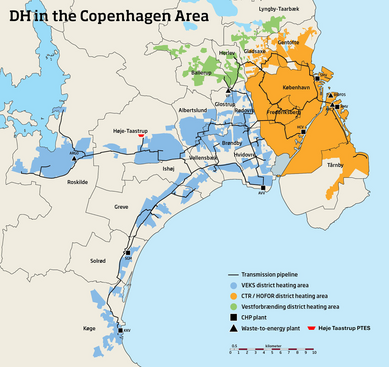
The city’s three district heating areas combine surplus heat from waste-to-energy plants with renewables and combined heat and power (CHP) to reduce CO2 emissions by three times compared to gas-fired systems.
Map: VEKS and Høje Tasstrup District Heating
We spent much of our time in Vestegnen, the suburbs west of Copenhagen, touring the VEKS district heating area. VEKS is a production, transmission and distribution partnership of 12 municipalities that operate as a nonprofit, with the district heating companies as its direct customers.
Natural Refrigerants Without Barriers
With their high global-warming potential (GWP), traditional refrigerants play an outsized role in the carbon footprint of heating and cooling systems. That’s why it was so refreshing to see state-of-the-art equipment using ultra-low GWP refrigerants wherever we went.
You’d see a heat recovery heat pump that uses R-290 (propane) as a refrigerant; since it’s being used to move energy versus being burned to produce energy, it has almost no environmental impact. Then you’d see another example – and another. All the equipment I would love to use in the U.S. was already in full operation here because it's allowed by law and by code.
To help address this gap, I sit on the American Society of Heating, Refrigerating, and Air-Conditioning Engineers (ASHRAE) ad hoc refrigerant safety committee. We are diligently working on safety testing and code updates that will allow these natural refrigerants and proven climate-smart technology to be used in the U.S.
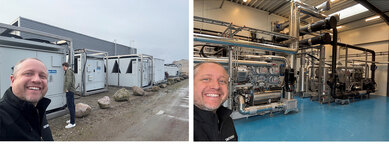
The author shares his enthusiasm for an air-cooled chiller that uses propane as its refrigerant (left) and an ammonia heat pump used for data center heat recovery in these district-energy selfies from the Copenhagen tour.
Turning Waste Heat into Net-Zero Energy
Waste-to-energy plants play an important role in Copenhagen’s district energy system. While much of this has historically come from waste and biomass incineration, there is a policy-driven trend towards converting the free waste heat from data centers into a source of continuous power. Our group toured a plant recovering waste heat from a data center using an ammonia heat pump. This reduces the direct emissions from the heat recovery process to virtually zero due to ammonia’s negligible GWP.
When you combine targeted policy with cutting-edge tech, modular central plant design, and a waste-heat recovery approach that pays for itself over time, you have an energy solution that is so maintainable and cost effective it can almost seem boring. Ultimately, it’s more like the country’s celebrated mid-century furniture. Elegant. Thoughtful. Danish.

A first-of-its-kind pit thermal energy storage facility outside Copenhagen. Graphic and Photo: VEKS and Høje Tasstrup District Heating
Thermal Energy Storage – Pit Style
Anyone who has been stuck sitting next to me for more than 5 minutes knows I love thermal energy storage and try to design it into all the systems I work on. So it was really inspiring to see ways we don't deploy it in the U.S. We took a bus to Høje Taastrup, where we toured a thermal energy storage network that uses a football-field size pit filled with 18-million-gallons of water to store and transfer heat energy.
It’s the first large-scale installation of pit thermal energy storage (PTES) of its type in the world, with a membrane and insulation design that allows for a constant water temperature up to 194 degrees F. The result is a sunken-pit thermal battery with a capacity of 3,300 MWh that can be continually recharged by waste heat and supplement wind and solar power.
In addition to serving four CHP plants and three waste-to-energy plants, there is a future opportunity to connect this PTES facility to residential customers through an ambient loop geothermal system. Already used in other parts of the region, these systems use a single, underground loop pipe that runs heated water to the heat pump in each home. Residents just pay a connection fee to be part of the network and gain access to low-cost heating and cooling. It’s all my favorite things rolled out together for everyone’s benefit.
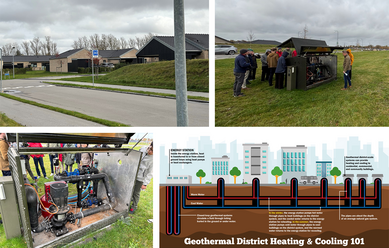
Using a surprisingly compact pump station for circulation, this residential neighborhood outside Copenhagen is linked directly to an ambient loop geothermal network. Diagram: U.S. Department of Energy
An Evolutionary Leap for Smart Thermostats
While Copenhagen’s district energy supply and distribution networks are impressive, they are also continually improving affordability and support for their end users. The city’s district energy providers use AI to proactively evaluate their customers’ system performance and identify homes that could benefit from efficiency boosts. If issues are identified, a letter is sent to the homeowners with the top recommendations for how to save energy.
It also says, “If you'd like us to come out and take a look, here's when we could do that. If anything needs to be replaced, here's a financing mechanism that would add that cost to your bill and spread it out over time.” It’s a holistic, thoughtful process providing an ambient loop of customer service and operational performance.
Distributing a Future That Already Exists
It was so inspiring to participate in IEA DHC – both for the knowledge sharing and for seeing firsthand how you could structure these systems for large-scale benefit and impact. Nearly two-thirds of Danish households are connected to the district energy network – and expansion continues. In Denmark’s four largest cities, 95% of the heat demand is met by district heating.
The future of district energy is already happening in Copenhagen, and it's safe, reliable and makes economic sense. Realizing this opportunity in the U.S. will not only require getting the needed codes, standards and policies in place, but replicating the benefits of waste-heat reuse and thermal storage with campus-scale applications like we’ve been working on with the University of California-Merced and the University of Michigan.
While it isn’t the future of tourism, it is definitely a key stop on our future energy itinerary.