Arizona State University's Interdisciplinary Science and Technology Building 12
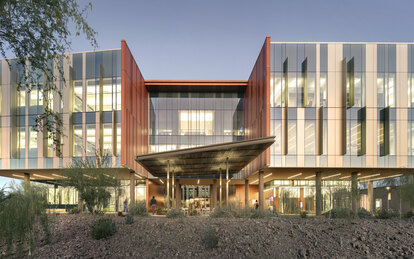
The Interdisciplinary Science and Technology Building 12 (ISTB12) is the flagship facility of Arizona State University’s (ASU) new Polytechnic Innovation Zone, serving as the centralized home for ASU’s new School of Manufacturing Systems and Networks, one of the nation's preeminent programs dedicated to manufacturing research.
Client
Arizona State University
Location
Mesa, Arizona
Markets/Services
Science & Technology, Lab Planning, Sustainable Design, MEP Engineering, Landscape Architecture
Furthering its vision to support new economies in the state, Arizona State University (ASU) introduced the School of Manufacturing Systems and Networks, augmenting the already successful and growing engineering programs at its Ira A. Fulton Schools of Engineering. SmithGroup designed and planned a new building to house the school, on a site that is a gateway between ASU’s engineering-focused Polytechnic campus and a new Innovation Zone that the university is developing in collaboration with the city of Mesa.
ISTB12 creates a premier center for experiential education and research into emerging manufacturing processes. As an incubator and a testing ground, it is advancing the nation’s manufacturing technologies and preparing students for highly skilled domestic manufacturing careers. The building represents a major expansion of ASU’s Polytechnic campus and the largest single investment in the development of the Innovation Zone. It establishes a powerful physical connection between the university and the new Innovation Zone —symbolic of the connections that will occur through research collaborations with industry partners. Industry partners integrate across the entire facility rather than within a single dedicated space, with proximity to Principal Investigators and students.
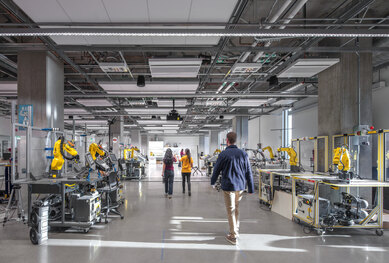
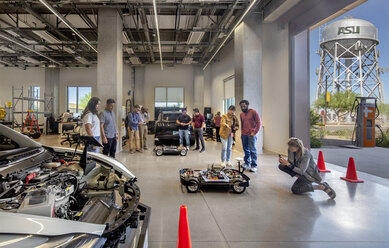
ISTB12 provides specialized labs for research thrusts in five key areas: additive manufacturing, robotics for smart manufacturing and industry automation, cyber manufacturing and operations research, semiconductor manufacturing, and energy-sector manufacturing. The first floor is dedicated to manufacturing research and testing, including high bay labs, reactive metal and 3D printing capabilities, and a Class 10,000 (ISO 7) clean room. A structural grid system supports the movement of heavy equipment. The second floor is devoted to instructional active learning and teaching labs for robotics, semiconductor production and other focus areas. The third floor provides flex space and room for future growth.
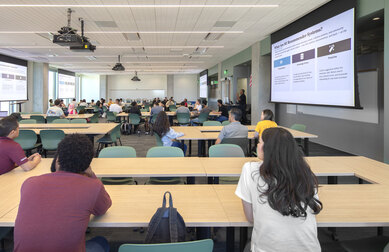
Laboratories, classrooms, offices, meeting rooms and support spaces are integrated throughout the building for maximum flexibility and interaction.
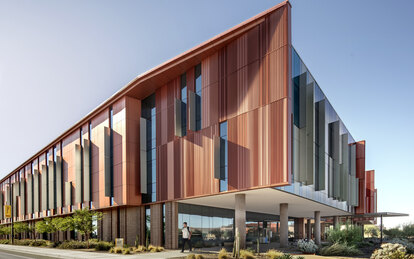
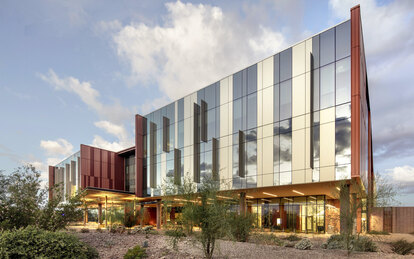
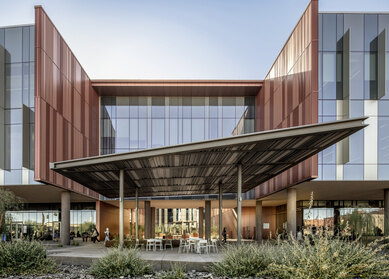
The three-story U-shaped design serves as a welcoming gateway from the southwest corner of the Polytechnic campus to the Innovation Zone, presenting an elevated “collaboration bridge” that forms a shaded courtyard and breezeway along the main pedestrian thoroughfare. The design complements and elevates the existing architectural character of campus, with highly articulated metal panels, concrete masonry columns and calibrated curtainwall fins.
ISTB12 mechanical systems leverage district cooling from the campus and are designed to integrate into planned district heating system utilizing heat recovery chillers to provide simultaneous heating and cooling while lowering water consumption. Dedicated outside air systems (DOAS) with heat recovery and direct evaporative cooling support a network of active chilled beams to minimize ventilation and reduce energy use. When including the building proposed design, building energy simulations project a long-term energy cost reduction of nearly 36% as compared to a minimally compliant ASHRAE 90.1-2010 baseline. This, together with other sustainability innovations, allows the building to target a LEED v4 Gold certification.
As the flagship of the Polytechnic Innovation Zone, ISTB12 marks a significant step forward for ASU’s School of Manufacturing Systems and Networks, playing an integral role to advance the manufacturing sector.