In the Spotlight: The Trends Shaping Performing Arts Venue Design
Theater connects us. Long before digital networks, performing arts venues were the original social platforms—places where music, dance, and drama brought people together. Today, in an era of rapid tech change and fragmented attention, that sense of shared experience is more important than ever. Modern venue design is evolving to foster accessibility, collaboration, and immersive engagement, ensuring these spaces remain cultural hubs that unite audiences and performers.
Universal Access: Designing Performing Arts Venues for All
The performing arts is a shared experience, enhanced when performers and audience members can feed off each other's collective energy. There is an ever-growing recognition that the best experience happens when all are able to participate. Particularly in existing venues, renewed focus is being placed on Universal Access – a core design philosophy which aims to create environments that can be processed, understood, and used by all.
Many historic venues, built long before accessibility standards existed, are now undergoing major renovations. Often the first step in transforming historic theaters to universally accessible facilities is a master plan, like the one SmithGroup completed for Washington, DC’s National Theatre, focusing on accessible circulation, technological capabilities for a variety of production types, and opening support spaces backstage for performers of all needs. For a university’s historic auditorium, SmithGroup designed a renovation focusing on technological enhancements and accessible egress to strengthen campus connections. Not only does this invite more students and community members to the sensitively upgraded space, but by expanding the entry lobby, pre-function events and classes can be held, encouraging formal and informal collaboration.
These renovations reflect the broader industry shift: accessibility is now intertwined with audience engagement. Attendee expectations are shaped by personalization and inclusivity. Venues that fail to meet these expectations risk alienating audiences who increasingly value comfort, autonomy, and equitable participation.
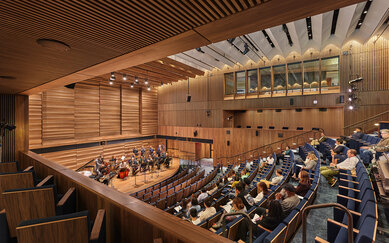
The theater of the renovated Johns Hopkins University Bloomberg Center is designed to flexibly host public and private events across the spectrum of music, film, and lectures.
Collaboration: Designing for a New Paradigm in Community Building
Participation in the arts has always focused on collaboration and the exchange of ideas. However, the emerging trend, particularly at higher education and civic institutions, is a re-imagining of what it means to contribute to the arts and includes an ever-expanding notion of the potential synergies between the arts, engineering, science, and any number of other disciplines and community-based organizations.
In the heart of Washington, DC, Johns Hopkins University’s Bloomberg Center is a state-of-the-art educational center, anchored by a flexible theater that can host everything from music concerts and film screenings to guest lectures and community events. Synergizing the arts and education, this unconventional venue supports exploration, ingenuity, and community on campus.
Today, other historically unconventional adjacencies are being located together, such as performance studios adjacent to engineering labs, allowing students to prototype robotics, projection systems, and interactive installations directly within performance spaces. Modular rooms are designed to be reconfigured into any number of varying layouts, enabling traditional, experimental, and interdisciplinary projects to coexist under one roof.
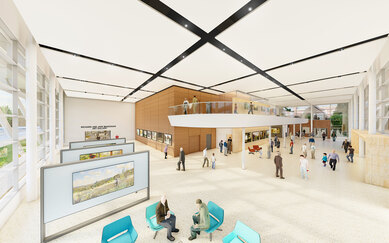
The design of the Paul and Carol Schaap Center for the Performing Arts includes gallery and event space beyond its flexible theater to encourage and enable further community use.
Public and multi-purpose spaces are being designed to both maximize utilization and promote community participation, such as at Paul and Carol Schaap Center for the Performing Arts in Grosse Pointe Park, Michigan. SmithGroup designed the holistic arts center with a flexible theater and a graciously proportioned lobby that also functions as a space for hosting rotating exhibits and events, all encompassed within a glassy exterior, welcoming in the surrounding neighborhood.
Instead of serving as isolated cultural institutions, venues are becoming civic and educational hubs where artists, scientists, educators, local residents, and community groups are encouraged to participate.
Engagement: Adapting to Evolving Audience Expectations
While traditional theatrical or musical productions continue to be a driver of performing arts programming, audience expectations are rapidly shifting, particularly among today’s younger generation of digital natives whose formative years have largely been shaped by on-demand services, social media, and an ever more fragmented society. As such, audience expectations have shifted toward experiential, exploratory, and emotionally resonant performances.
Audiences now crave intimate environments and non-linear productions, and venues are adapting by prioritizing smaller, flexible rooms that can be reconfigured for promenade-style performances, interactive installations, or multi-sensory storytelling. Instead of a single proscenium stage, a venue might include a constellation of microspaces—each capable of hosting a different scene, character interaction, or sensory experience.
The trend toward personally tailored programming extends to the time outside of the performances themselves. Offerings such as behind the scenes tours, meet and greets with the performers, VIP dinners, or bespoke receptions can serve the dual purpose of providing audience members with increased access and connection to the productions, while also providing opportunities for venues to increase the hours they are open to the public and help drive new sources of revenue in a challenging economic environment.
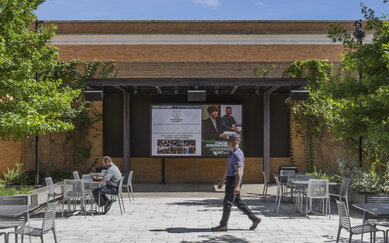
The renovated courtyard of the Music Building at the University of North Texas now enables a multitude of functions.
At the University of North Texas, SmithGroup designed a renovation of the Music Building courtyard as an ambitious micro-intervention, establishing a versatile outdoor respite and concert venue while redefining the arrival experience for the complex as a whole. The courtyard now provides ample space for pre- and post-concert events and is designed for and technologically equipped for both live and multi-media performances.
Performing Arts Venues: Today's Cultural Engines
The trends shaping the performing arts – Universal Access, Collaboration, and Engagement – are not new ideas, but they are being re-imagined in completely new ways to engage with today’s audiences.
Design that prioritizes performer and audience access reflects a commitment to equity and inclusion. Interdisciplinary spaces encourage cross-organizational integration and innovative programming, promoting new modes of collaboration and community building. Finally, tailored theater experiences are reshaping venues into adaptable, intimate environments that meet the evolving expectations of today’s audiences.
Together, these trends signal a future in which performing arts venues are not static buildings, but dynamic cultural engines—spaces designed to evolve, respond, and inspire.