Virginia Tech Academic Building One
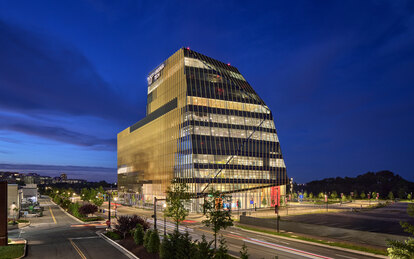
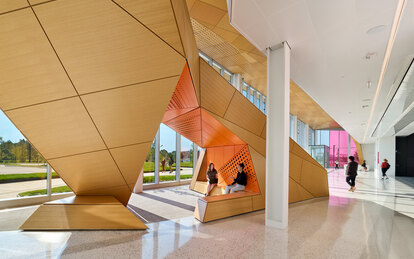
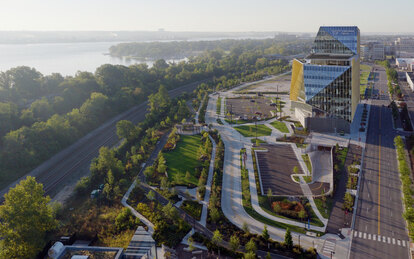
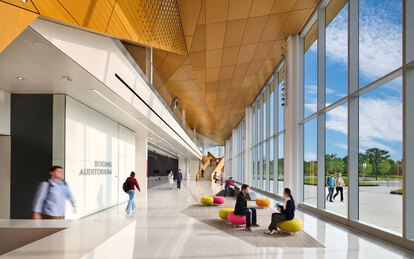
Academic Building One is a forward-looking model for the future of academic design. Through the seamless integration of technology, sustainability and human-centered spaces, the project demonstrates how architectural design can transcend traditional boundaries to influence a campus—and the evolution of an entire industry and region.
Client
Virginia Polytechnic Institute and State University
Location
Alexandria, Virginia
Markets/Services
Architecture, Higher Education, Landscape Architecture, MEP Engineering, Sustainable Design
Featured Awards
Metropolis Planet Positive Awards, Higher Education, 2026
Interior Design Best of Year Awards, 2025
A Strategic Hub in the Capital Region
Virginia Tech’s Academic Building One is a new blueprint for education and innovation. The landmark building in Alexandria, VA, anchors the Institute for Advanced Computing and builds on the State of Virginia’s $1.1 billion Tech Talent Investment Program; the same initiative that drew Amazon’s HQ2 to the region and continues to drive innovation across the state.
Academic Building One expands Virginia Tech’s presence beyond its Blacksburg campus creating the most diverse tech graduate program in the United States, hosting approximately 750 master’s and 200 doctoral students in computer science and computer engineering. At its core, the 300,000 SF project fosters collaboration between students, faculty, and industry in a dynamic, innovative-driven environment. More than a building, it’s a model of design excellence and a catalyst for the region’s tech ecosystem.
The design of the building embodies Virginia Tech’s vision
The principles of sustainability, health and wellness, green and social spaces, accessibility, connectivity, flexibility, and integrated technology were all key to the design of the 300,000-square-foot facility.
Computational Design
Advanced computational design techniques were used to explore more than 1,400 different massing options to arrive at the final form. Custom digital tools informed the selection of the façade system, ensuring a design that is efficient and site-specific. The project is one of the first in the U.S. to use building-integrated photovoltaic (BIPV) panels, embedding PV in the outer layer of insulated glass. PV fins on the south façade and a rooftop PV trellis combine to generate energy. Terra cotta fins on the east and west façades provide passive shading, mitigating solar heat gain and glare. The outcome is a high-performance, faceted structure optimized for energy efficiency, zoning, and occupant comfort, achievements made possible only through this computational technology.
Sustainability At Scale
Academic Building One features next-generation mechanical systems and computationally optimized passive shading strategies to reduce energy use. High performance systems include the largest known BIPV façade in North America, a Dedicated Outdoor Air System (DOAS), chilled beam technology, and an upper roof structure designed for future phase additional PV, as well as connections to a future planned Sewage Wastewater Energy Exchange and geothermal systems.
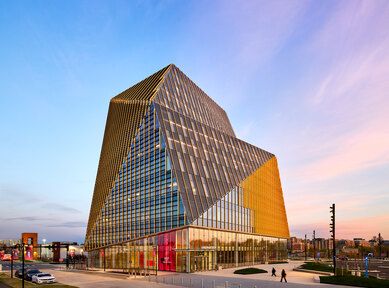
The building is also fully electrified, making it one of the few large-scale structures on the East Coast to have no fossil fuels combustion on site. The only exception is emergency generators, as mandated by building codes. Primary heating and cooling equipment are modular, enabling it to be installed in a phased manner to match the load. By relying on fossil fuels only for emergency generators, the fully electric building is engineered to become increasingly cleaner over time as the U.S. power grid transitions to greener energy sources. The project also incorporates three different photovoltaic technologies that will produce 387,713 KWH/YR of electrical power (equivalent to power for 36 to 40 households). Overall, the project's energy strategies aim toward a net-zero energy future.
Human-Centered, Inclusive Design
The building emphasizes human-centered, inclusive design that supports wellbeing. Light-filled collaboration areas, quiet zones, and “home base” spaces create a welcoming environment for students and faculty. Wellness features — such as ART‑inspired restoration stations, Re-Center and Mental Passport Rooms, stretching areas, and stairwell distance graphics — promote relaxation, cognitive restoration and physical activity. Spaces like the eighth‑floor “Tree House” lounge use natural materials and abundant sunlight to offer restorative retreats. Designed with neurodiversity and biophilic principles, the interiors balance technological needs with human comfort.
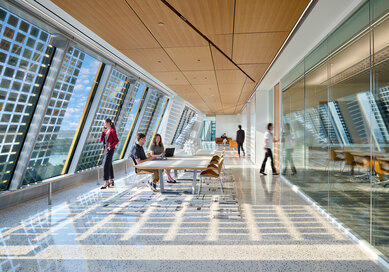
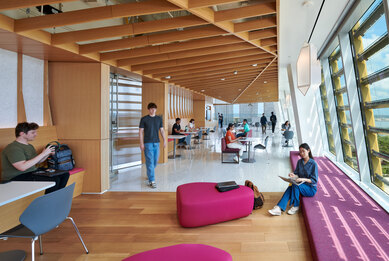
Outdoor classrooms and seating areas encourage social interaction through flexible, non-linear arrangements, accessible grading, and inclusive furniture. Exterior glazing and PV-integrated glass bring dappled natural light into the building, creating dynamic patterns that enhance calm, connection, and overall wellbeing.